The High Achiever’s Paradox: Competent, Credentialed, & Still Paralysed by Self-Doubt

Self-doubt isn’t a personality flaw. It isn’t weakness. It isn’t evidence that you’re not cut out for the thing you’re pursuing.
It’s the Minotaur. One of the biggest people face; I would know, I faced it too. I talked a lot about this anxiety in the first few posts I published.
And like every Minotaur, it lives in the dark, in the parts of your mind you haven’t examined, in the beliefs you inherited before you were old enough to question them, in the voice that tells you to stay small, stay safe, stay silent.
I know that voice well. For the first thirty years of my life, it ran the show.
I was the the guy who couldn’t make a dentist appointment without trembling. I avoided phone calls, networking events and any situation that required me to be visible.
Intelligent enough to know I was capable of more. Terrified enough to stay exactly where I was.
Overcoming Self-Doubt
What I didn’t understand then, and what most people never figure out, is that self-doubt isn’t something you eliminate. It’s something you face. Repeatedly. Deliberately. Until facing it becomes so familiar that it no longer has the power to stop you.
That’s the work Minotaur Mastery was built around. Not the elimination of fear. The systematic dismantling of everything that keeps you from moving forward in spite of it.
It’s based around the Greek Myth of Theseus and the Minotaur. Below you see an ancient cryptic maze. That’s symbolic of the maze in your mind – some parts you’re aware of, most parts you’re not.
It gets confusing, you don’t know what’s around the corner. Usually it’s the minotaur of self-doubt, fear, insecurity, anxiety and so on.
That’s the internal maze in your mind. The external maze is your life, these days, more chaotic than ever.

The Science of Confidence & Unravelling the Mystery
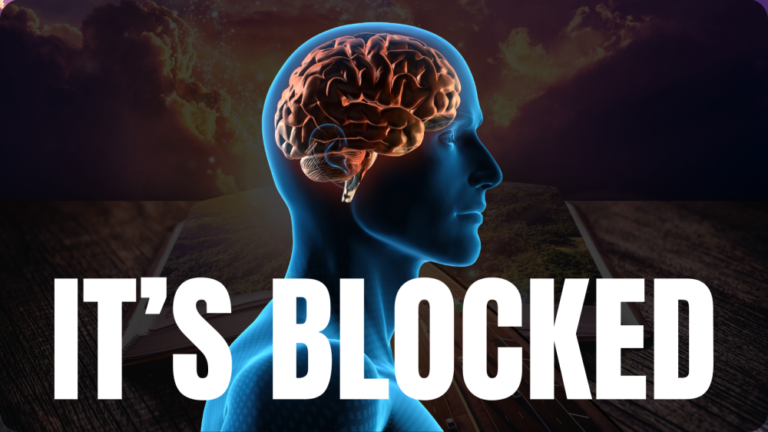
Here’s what most self-help content won’t tell you: confidence isn’t a trait. It’s a neurological by-product of repeated action.
When you do something difficult and survive it, your brain updates its model of what you’re capable of. Dopamine reinforces the behaviour. Neural pathways strengthen.
The next time you face something similar, the resistance is slightly lower, not because you’ve become someone different, but because your brain now has evidence that you can handle it.
This matters because it means confidence is not something you wait to feel before you act. It’s something you build by acting before you feel it.
The sequence matters. Action comes first. Confidence follows. More importantly, so does self-esteem.
Even the most visible, seemingly fearless people carry self-doubt. The difference between them and the person who stays stuck isn’t the absence of that doubt; it’s the decision not to let it have veto power.
They’ve learned to act alongside the fear rather than waiting for it to disappear.
That’s not an accident of personality. It’s a learnable skill. And the neuroscience backs it up.
As does my own personal experience; making videos online repeatedly wasn’t about social media views; it was about rewiring my mind on how I felt about attention.
Understanding the Root of Self-Limiting Beliefs
Self-limiting beliefs don’t appear from nowhere. They are installed…by school systems that rewarded conformity over curiosity, by workplaces that valued compliance over authenticity, by a society that told you your worth is tied to your title, your salary, your status.
Most professionals have spent decades absorbing these beliefs without ever questioning whether they’re true.
I’m not good enough for this room. I don’t have the credentials to say this publicly. People will judge me if I put myself out there. Who am I to build something of my own?

These aren’t facts. They’re conditioning. And conditioning can be undone, but only if you first become aware that it’s there.
Sometimes you just need a little help, like the thread of Ariadne, depicted in this picture here.
The Think stage of the TECA framework is that start of such a thread. Before you change anything externally, you have to examine what’s running internally.
The Story You Tell Yourself
What stories are you telling yourself about your own capability? Where did those stories come from? Are they actually yours, or did someone else write them for you?
I talk often about societal conditioning and programming. I’ve been fascinated by psychology ever since accidentally taking it up at A-Level. You come to realise almost everything is conditioning of some sorts.
Challenging these beliefs therefore, starts with that moment of awareness. The next time you catch yourself in a spiral of self-doubt, stop. Ask one question: is this belief based on evidence or conditioning? Most of the time, you’ll find it’s the latter.
Then rewrite the narrative. Not with toxic positivity; not “everything is great and I’m amazing”, but with honest reframing.
Replace “I can’t do this” with “I haven’t learned this yet.”
Replace “I’m a failure” with “this didn’t work and I know more now than I did before.”
It feels uncomfortable at first. Stupid even. That discomfort is the Minotaur resisting. Keep going. You need to have complete mastery over that voice in your head. The next time you hear it, ask it, who’s voice are you really?
Why AI Is Making Self-Doubt Worse for Professionals Right Now
There’s a specific version of self-doubt hitting professionals today that didn’t exist five years ago.
It’s not the classic imposter syndrome: the fear that you’re not qualified enough for the room you’re in. You’ve been in the room for fifteen years. You have the qualifications. You’ve delivered the results.
It’s something more destabilising than that. It’s the sudden uncertainty about whether the room itself still exists.
When AI can produce in four hours what used to take a qualified professional four days, the expertise that anchored your identity stops feeling like solid ground. The question shifts from “am I good enough?” to “is what I’m good at still worth anything?”
That’s a different Minotaur entirely. And it’s one that competence alone cannot answer, because competence was never the issue.
The professionals who navigate this well are not the ones who simply learn to use AI tools. They’re the ones who do the internal work first; who get clear on what they actually bring that compounds rather than commoditises, and who build the visibility to communicate that value before someone else decides it for them.
The self-doubt you’re feeling right now isn’t weakness. It’s the correct response to a genuinely uncertain environment. The question is whether you face it and move, or let it keep you exactly where you are while the world reorganises around you.
Practical Steps to Build Unshakeable Confidence
Confidence is not a feeling you wait for. It’s a skill you build through action; specifically through repeated exposure to the things that currently make you uncomfortable.
There are many definitions of confidence. I like to define it as the relationship you have with other people. Self-esteem being the relationship you have with yourself, and communication being the bridge between the two.
You can be outwardly confident, with the way you speak with other people; whilst your self-esteem and self-worth is shot. And vice verse. However, all 3 are skills you can develop; no matter where you currently are.
This is what I did. I started making videos when the thought of being on camera made me feel physically sick. I launched a podcast when I could barely hold a conversation with strangers.
Not because I felt confident. Because I understood that confidence comes after the action, not before it. But even that’s a lie…I didn’t even think about confidence in and of itself. I just knew I had to become a better communicator – and there was a lot of psychological baggage holding me back.
Start small. Set goals that stretch you without breaking you. Every small win, a video published, a conversation had, a room entered, builds the neural evidence that you are capable.
That evidence accumulates. Over time, it becomes the foundation of genuine self-belief rather than performed confidence.
Mental Rehearsals
Visualisation helps, but only when paired with action. Mentally rehearsing a difficult conversation or a camera recording reduces the anxiety around it. It makes the unfamiliar feel slightly more familiar before you begin. Use it as preparation, not as a substitute for doing the thing itself.
But visualisation alone means nothing without action – trust me, I tried. The Secret and other Law of Attraction books make you feel good, but you do nothing. The real work is in the action.
And pay attention to your physicality. How you carry yourself affects how you feel and how others perceive you.
Head up, shoulders back, eye contact held, these aren’t vanity. They’re signals you send to your own nervous system as much as to the room. The body leads and the mind follows more often than we think.
For those of you that remember, I did 75-Hard around the covid period. I kid you not, I felt taller. The energy radiating from me was electric. Physicality matters more than you think.
Leveraging Support Systems
The myth of the self-made person is one of the most damaging stories modern culture tells.
Theseus didn’t defeat the Minotaur alone. He had Ariadne, someone who believed in his mission and gave him the tools to succeed: the sword and the string.
Every genuine transformation has an Ariadne. A mentor, a community, a person who sees something in you that you’re still learning to see in yourself.
I had an initial group where we helped each other get confident making videos. I was by far the worst of the lost. Ironically, I’m now probably the strongest, and the one who continued the most.
Building a support system isn’t a soft strategy. It’s a structural one. Surround yourself with people who are also doing the work; questioning the narrative, building something aligned with their values, refusing to accept the comfortable version of themselves.
Change Your Environment
That environment shapes you. Choose it deliberately. Or stay stuck like a crab in the bucket.
Mentorship accelerates everything. A good mentor doesn’t just share knowledge, they hold a mirror up to where your self-doubt is distorting your perception.
They’ve walked the terrain and can tell you which fears are worth paying attention to and which ones are just the Minotaur making noise.
Don’t wait until you feel ready to seek support. The moment you feel most alone in the work is usually the moment you most need to reach out.
Asking for help isn’t a concession of weakness. It’s one of the most strategically intelligent things you can do. Not being able to ask for help is a sign of low self-esteem and low confidence. I could never do it before; now I do it often – even if it’s just to exercise my self-esteem.
Maintaining Momentum and Striving for Continuous Growth
Building confidence is not a destination. It’s a practice.
You don’t reach a point where self-doubt stops appearing. What changes is your relationship with it. You stop being surprised by the fear. You stop letting it make decisions for you.
You’ll have moments in your life, appearing around the corner, seemingly out of nowhere, that stuff your self-worth and confidence. That give rise to self-doubt. It’s a constant battle. Not one you win and that’s it forever.

When setbacks come, and they will, with forks in the road leading down a dark path where you can’t see what’s on the other side…
…the question isn’t how to avoid feeling knocked back. It’s how quickly you can return to the work.
Resilience isn’t the absence of difficulty. It’s the shortened recovery time between the difficulty and the next attempt. You just gotta get up.
Falling Down
I love the line from Batman Begins, when a young Bruce Wayne falls down into the crypt. His father pulls him up and says, “What do we do when we fall down?! We ge right back up!” That might not be the correct wording, but it’s the wording I use with my children.
Keep learning. Not because you’re deficient, but because growth is what makes the journey feel meaningful rather than mechanical.
New skills, new perspectives, new rooms you’ve never been in before; these keep you sharp and remind you that you are still becoming, not already finished.
Celebrate what you’ve built. Not as a performance, but privately, honestly. Note what you’ve done that the previous version of you couldn’t.
That recognition isn’t arrogance. It’s evidence. And evidence is what dismantles self-doubt more reliably than any affirmation ever could. Take a note of it, right it down. Come back to it during future moments of doubt.
The confidence you’re looking for isn’t waiting on the other side of the right conditions.
It’s built in the middle of the wrong ones.
Self-esteem and self-doubt go hand in hand. Life is a maze. Your mind is a maze. Their are Minotaurs everywhere. You can either hide, or you can:
Enter the maze. Face the Minotaur. Come back changed.
That’s the only path that works and makes life worth living. What will you do?